
Stirling vs Prochazka breakdown: how 31 leg kicks set up the knockout at UFC Qatar
Stirling vs Prochazka breakdown from UFC Qatar: 31 significant leg kicks, a first round spent below the waist, and a knockdown with one second left in round 2.
By Mate BersenadzePublished: Read time: 4 min read

The knockout will be the clip everybody shares: one punch at range, Jiri Prochazka down with one second left on the clock in round 2, Marc Goddard in to stop it at 4:58. It was a good punch. It was also the 48th significant strike Navajo Stirling landed, and 31 of the 47 before it went to the same place, which is why the punch landed at all.
In the preview I wrote that the first ten minutes belonged to Stirling, that Prochazka wins in round 3, and that if he was still standing at the start of the third with his output climbing, it would be the Khalil Rountree Jr. fight all over again. He was standing at 4:57 of round 2. What follows is how Stirling made sure the third round never started, worked from the official round-by-round tracking: where each strike landed, from what range, and how long they spent in each position.
Round 1: everything below the waist
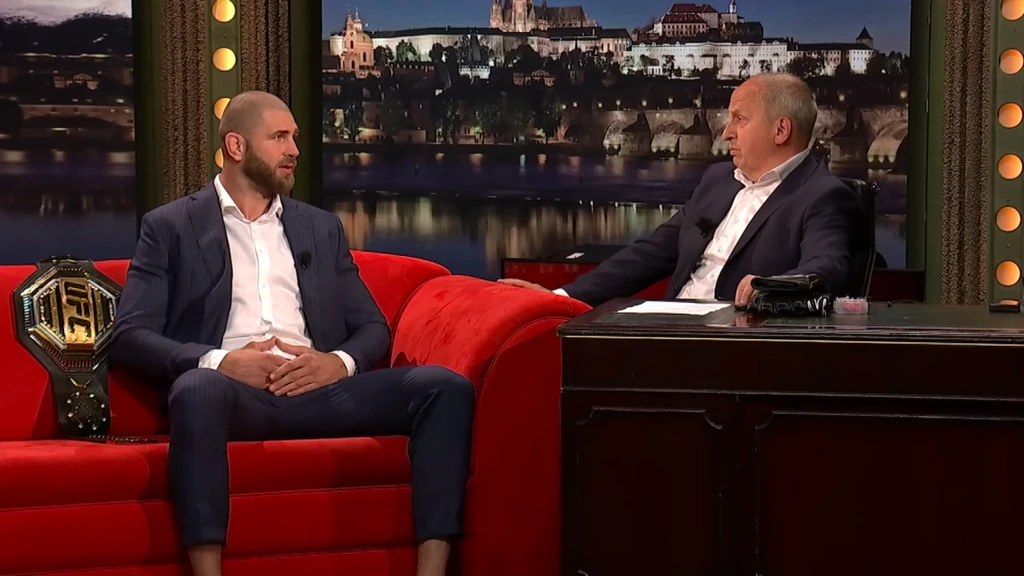
Photo: Show Jana Krause / CC BY 3.0

Here is the first round as the tracking counted it, significant strikes landed of attempted, all of it at distance:
Look at the Stirling column from the bottom up. Twenty-eight attempts at the legs and 21 landed, a kick connecting roughly every 14 seconds for five minutes. Ten attempts at the body. Thirteen at the head, and one landed. That isn't a man who missed his punches. It's a man who threw them to keep Prochazka's eyes up while the real work happened down low.
The kickboxing logic is old and it's good. A fighter who builds his offense on long entries from outside needs his feet more than his hands. Kick the base and every entry gets slower, or shorter, or both. You don't need the leg to buckle. You need the next step in to start a quarter-second late.
Prochazka answered with seven leg kicks of his own. He also got his only control of the fight, 18 seconds on the floor. Two of the three judges still gave the round to Stirling. Sal D'Amato gave it to Prochazka. If you score the head and nothing else, I see why. I don't, and neither did the other two.
Round 2: the target moves up
| Target | Stirling | Prochazka |
|---|---|---|
| Head (distance) | 4 of 19 | 6 of 14 |
| Body (distance) | 3 of 4 | 0 of 0 |
| Legs (distance) | 10 of 14 | 5 of 5 |
| Clinch | 3 of 4 | 1 of 1 |
| Ground | 2 of 2 | 0 of 0 |
Two things changed. Stirling's leg attack dropped from 28 attempts to 14, and his head attempts went from 13 to 19. And Prochazka had his best stretch of the fight: 6 of 14 to the head, five of five to the legs, the first clinch exchange of the night (28 seconds of it). If you were watching for his comeback, this was it starting.
This is the part I would point at on a paused screen. Prochazka's best moments of the fight came when he finally got into range, and getting into range is exactly what ten minutes of kicks to the base had made expensive. He threw only 45 significant strikes in the entire fight, 4.5 a minute. In his nine previous UFC fights he averaged about 10 a minute, and this was the lowest rate of all ten. I think the legs are the reason. Stirling didn't have to out-work him. He had to make every entry cost something.
Then, with seconds left in the round, the head opened. The knockdown is logged with one second on the round clock. Stirling's last two significant strikes are logged on the ground, the follow-up shots before Goddard got there. The official time is 4:58.
What the tracking says about range
Of the 9:58 they fought, 9:10 was at distance. They spent 28 seconds in the clinch and 20 seconds on the floor. Stirling landed 43 of his 48 significant strikes at distance. Everything about this fight was decided in the space between the two men, which is the space Prochazka has always tried to close fast and Stirling spent ten minutes making slow.
Both landed at the same rate, 51 percent of significant strikes attempted. Stirling just attempted twice as many, and aimed nearly half of them at the legs.
The principle, and the next problem
The fix for this is not new either: check the kick, or punish it. He did neither often enough, and his own leg kicks, 12 of 14 landed across the fight, came back as trades rather than counters. Against a kickboxer throwing twice as many, a trade on the legs is a trade you lose by volume.
For Stirling, the question the next opponent asks will be the one Prochazka never got to: what happens when someone takes the legs away by taking the fight to the floor. Magomed Ankalaev is the No. 1 contender. I wrote about what comes next separately. On Saturday, the answer to the third-round question was simple. There wasn't one.
More from the blog
- Is Jiri Prochazka finished? The numbers after the Stirling knockout
- UFC Qatar payouts: how much did Navajo Stirling, Jiri Prochazka and every fighter make?
- UFC Qatar results: Navajo Stirling knocks out Jiri Prochazka at 4:58 of round 2
- Who is Navajo Stirling? The unbeaten New Zealander headlining UFC Qatar against Jiri Prochazka
- UFC Qatar: how Jiri Prochazka beats Navajo Stirling, and why it starts in round three