
Gane vs Hokit breakdown: how Ciryl Gane beat 30 takedown attempts and won the clinch at UFC 334
Gane vs Hokit breakdown: Josh Hokit shot 30 takedowns and led every card after round 3. The fight log shows how Ciryl Gane won the clinch and kept his title.
By Mate BersenadzePublished: Read time: 9 min read
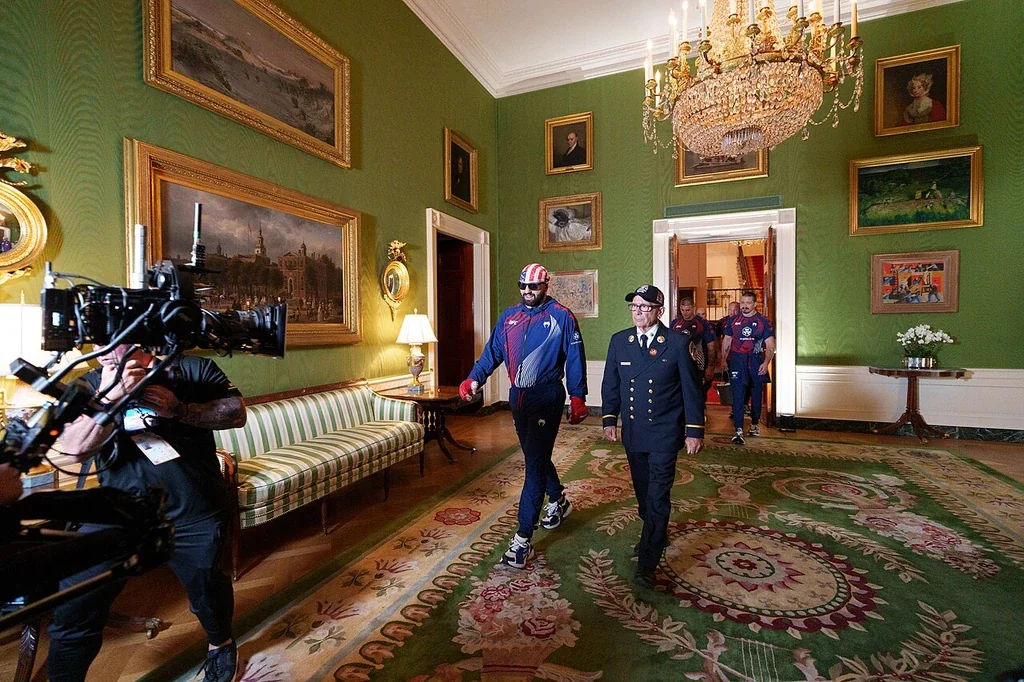
Josh Hokit shot for Ciryl Gane's legs three seconds into the heavyweight title fight at UFC 334. Eleven seconds later he shot again and put the champion on the mat. By the final horn at Madison Square Garden he had shot 30 times, finished three, and lost 48-47 on all three cards.
The easy version of this fight is "the wrestler faded and the kickboxer took over." I don't think the sheet supports it. Hokit never stopped shooting. He opened all five rounds with a takedown attempt inside the first four seconds, and he shot as many times in the fifth round as in the first. What changed was where the fight lived. The takedowns mostly didn't finish, so the fight settled into the clinch, more than ten minutes of it, and the clinch turned out to be a place Gane had barely visited in 14 UFC fights. He won it anyway.
I'm working from three things: the official in-fight log, which stamps every takedown attempt with its clock; the position stats, which split the 25 minutes into time at distance, in the clinch and on the ground and say where every significant strike landed; and the judges' cards. The log counts the clock down, so every time below is converted to time elapsed in the round. There were no knockdowns, no submission attempts and no referee stoppages of any kind, so this is a story about positions, not moments.
Five rounds on one sheet
| Round | Sig. strikes (champion-challenger) | Challenger takedowns | Challenger control | Time in clinch | Judges (champion-challenger) |
|---|---|---|---|---|---|
| 1 | 41-29 | 2/7 | 0:57 | 0:24 | 1-2 |
| 2 | 56-39 | 0/7 | 0:20 | 1:32 | 2-1 |
| 3 | 30-24 | 1/5 | 1:14 | 3:11 | 0-3 |
| 4 | 40-21 | 0/4 | 1:54 | 3:40 | 3-0 |
| 5 | 70-33 | 0/7 | 0:12 | 1:37 | 3-0 |
| Total | 237-146 | 3/30 | 4:37 | 10:24 | 48-47 x3 |
Gane won the significant-strike count in every round. He still lost six of the 15 round scores, and after three rounds he trailed 29-28 on every card. His own control time for the night: four seconds.
Round 1: two takedowns, 48 seconds on the floor
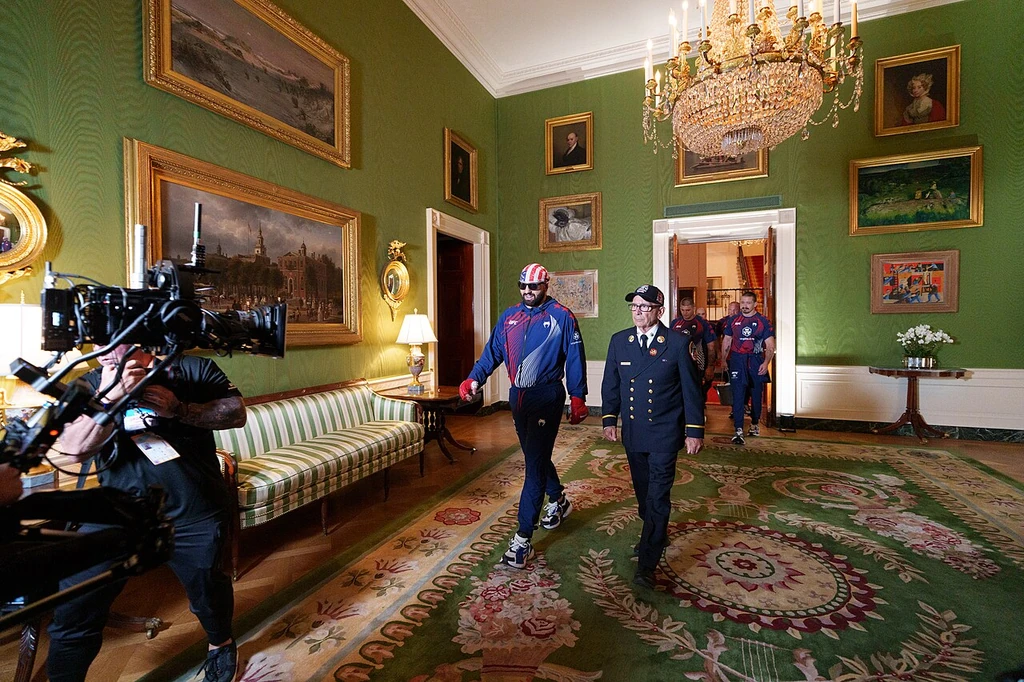
Photo: The White House / Public domain

The quickest way into Hokit's plan is the timestamps. Attempt at 0:03. Attempt at 0:14, landed. Then 1:51, 2:30, 3:10, 3:39, and a shot at 4:17 that he finished at 4:20. Seven shots in five minutes is a wrestler's pace at any weight.
Two of them landed, and that is the part people will remember. Here is the part they won't: the round logged only 48 seconds on the ground in total, and the second takedown came with 40 seconds left. Gane was off the mat from the first one in a hurry. Hokit's ground control in the round was 36 seconds in half guard and 12 in other top positions, and he landed 2 significant strikes down there. They were the only ground strikes either man landed all night.
Everywhere else, round 1 belonged to Gane's range. The round spent 228 of its 300 seconds at distance, and he landed 39 of his 41 significant strikes there, seven of them to the body. Adrian Castro scored it for Gane. Chris Lee and Sal D'Amato gave it to Hokit for the takedowns. Two takedowns in a round is a real argument, and I won't pretend that split is a scandal.
Round 2: seven shots, nothing
Same plan, worse return. Shots at 0:03, 0:32, 1:41, 2:29, 3:14, 4:14 and 4:50, and every one stopped. Hokit's 20 seconds of control all came in the clinch, and Gane landed 52 of his 56 significant strikes at distance.
This is the round I can't find on Castro's card. Gane out-landed Hokit 56 to 39, stuffed seven takedowns and gave up 20 seconds of control, and Castro scored it for Hokit, the only judge of the three who did. The closest thing to a case on the sheet is the clinch: Hokit landed 19 of 20 total strikes in there, only one of them significant, and short work in close can sound louder from a cageside seat than it reads on paper. Lee and D'Amato went Gane.
Round 3: Hokit's best five minutes
Round 3 is where the fight moved indoors. Time at distance fell from 195 seconds to 98, and the clinch went from 92 seconds to 191. Hokit landed his third and last takedown at 1:26 (the shot started at 1:24), got 11 seconds on the floor out of it, and spent most of the rest of the round chest to chest.
Here the clinch was his. He landed 15 of 17 significant strikes to the head in close and out-landed Gane 16 to 10 in the clinch, and his 71 total strikes in the round included 18 to the legs, none of which counted as significant. Gane still won the significant count, 30 to 24, on the strength of what he did at range. All three judges went Hokit anyway: the takedown, 1:14 of control and 71 total strikes to 37.
That's a fair round for the challenger, and it set the problem for the last ten minutes: after it every card read 29-28 Hokit, and the champion had to win both championship rounds outright on all three.
Round 4: held for 1:54, and 19 for 19 to the body
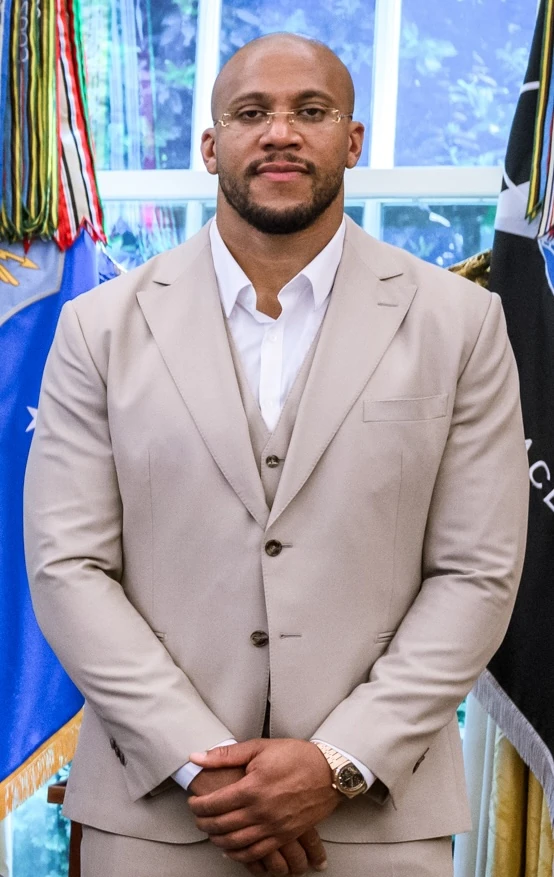 Photo: The White House / Public domain

Read only the control column and round 4 is Hokit's. He held Gane for 1:54, his most of any round, every second of it in the clinch. The round spent 220 of its 300 seconds in the clinch and 80 at distance, and for the first time in the fight there was no ground time at all.
Now read the strike grid. Inside those 220 seconds, Gane landed 27 significant strikes in the clinch to Hokit's 4. Eight went to the head. Nineteen went to the body, and he threw exactly 19. The grid records target and position, not the weapon, so I can't tell you how many were knees and how many were short shots under the arm, and I'm not going to guess. What it does say is that the man being held did nearly all the hitting. Control time measures who has the better grip. It doesn't measure who is winning the exchange, and all three judges scored the exchange.
The shot log is the other clue. Hokit shot at 0:04, 0:07 and 0:38, and then not again until 4:30. That's 3:52 without a takedown attempt, the longest gap of his night, spent leaning in the clinch instead of changing levels. I don't know whether that was a plan or the tank, and the sheet can't tell me. What it does tell me is that a clinch with no takedown threat behind it is a clinch the other man is free to work in, and Gane worked.
The history makes this round stranger. In his 14 UFC fights before Saturday, Gane spent 838 seconds in the clinch combined, and his longest night there was 256 seconds against Jairzinho Rozenstruik at a 2021 Fight Night. Across those 14 fights he landed 28 significant clinch strikes to the body. On Saturday he landed 34, 19 of them in this round alone. The division's best kickboxer turned out, at 36, to have a clinch game he had never needed to show us.
Round 5: back out to range
Hokit went back to shooting: 0:02, 0:21, 2:04, 2:18, 3:23, 3:38 and 4:47. Seven attempts, the same as rounds 1 and 2, and none landed. That's the detail that kills the "he gassed" story for me. A man who's empty doesn't shoot seven times in the last five minutes of a title fight. He was still trying to wrestle. He just couldn't get there anymore.
With the shots stuffed, the fight went back to distance, 203 seconds of it, the most since round 1, and range is where Gane lives. He landed 70 of 98 significant strikes, 55 of them at distance and 18 to the body, and gave up 12 seconds of control. Hokit landed 33 of 74. All three judges gave Gane the round, and the fight finished 48-47 three times.
The 30 shots
Thirty takedown attempts is the second-highest total in a UFC heavyweight fight in our stats archive, which covers 820 of them. The only man above it is Cain Velasquez, who tried 33 against Junior Dos Santos at UFC 155 and landed 11. That fight also ranks above this one on the clinch list: 682 seconds there, 624 here, which is sixth among 770 UFC heavyweight bouts with tracked positions. Same blueprint, very different conversion. Velasquez finished a third of his shots. Hokit finished one in ten.
That 10 percent is not what either man's history predicted. Gane's 14 previous UFC opponents tried 17 takedowns between them and landed 9. Hokit, across his five previous fights with official stats (his Contender Series fight and four in the UFC), landed 9 of 19. On Saturday Gane stopped 27 of 30.
And the three that landed bought almost nothing. The whole fight spent 72 seconds on the ground. Francis Ngannou kept Gane on the floor for 492 seconds at UFC 270, and Alexander Volkov for 453 at UFC 310. Those were the two fights that drew the map for Hokit. He followed it all the way to the door, 30 times, and never got through.
What the numbers expected
Our model gave Gane 61.2 percent on fight day. The sportsbook consensus just before the first bell had him at -219 and Hokit at +182 across 18 books. The prop board's shortest single outcome was Gane by knockout at +123, the fight going the distance was +204, and Gane by decision was +351. Odds here are information only, not betting advice. The market had the winner right and the road wrong: it expected the champion's hands to end it and the challenger's wrestling to be the danger. The wrestling never ended anything, and the hands needed all 25 minutes.
Our pre-fight breakdown closed on the line "He needs one round on top, and then another one." Hokit got 72 seconds on top across five rounds. The UFC 334 results recap has the rest of the card, and the bout page carries the full round-by-round log.
What a stuffed takedown leaves behind
The lesson I take out of this one isn't Gane's takedown defense, good as 90 percent is. It's where a failed shot leaves you. Every stuffed attempt on Saturday ended in one of two places. Back at range, where Gane out-landed Hokit 179 to 118 over the fight. Or in the clinch, where over the last two rounds he out-landed him 42 to 6.
Hokit needed the takedown to be the end of the exchange. Against a man who wouldn't stay down, it was the start of one he kept losing. Fight of the Night, and deservedly. It just turns out the most important ten minutes of it were spent in a hug, and only one man was punching his way out.
More from the blog
- UFC 334 results: Gane outpoints Hokit, Harrison submits Nunes in round 4
- Who is Josh Hokit? The UFC 334 challenger who went from the Contender Series to a title shot in 15 months
- UFC 334 predictions: picks for all 13 bouts, Gane vs Hokit and Harrison vs Nunes
- UFC 334 rankings stakes: what Gane vs Hokit and Harrison vs Nunes mean for both title pictures
- UFC 334 breakdown: how Josh Hokit beats Ciryl Gane, the way Ngannou and Jones did